
How to Choose the Right Career: A Practical Guide for Students and Young Professionals

Choosing the right career is one of the most important decisions you will make in your life. It influences your professional growth, financial stability, lifestyle, personal satisfaction, and future opportunities. Yet, for most students, deciding on a career path can feel overwhelming.
With hundreds of career options, thousands of educational programs, and a rapidly evolving job market, it’s natural to wonder: How do I know which career is right for me?
The truth is that there is no universal formula for choosing the perfect career. However, there is a process that can help you make a more informed and confident decision.
As Confucius famously said:
“Choose a job you love, and you will never have to work a day in your life.”
While every profession comes with challenges, choosing a career that aligns with your strengths, interests, and aspirations can make your professional journey significantly more fulfilling.
Understanding Today's Career Landscape
The world of work is changing faster than ever.
Artificial intelligence, automation, digital transformation, remote work, and emerging technologies are continuously reshaping industries and creating entirely new career opportunities.
This means students are no longer limited to conventional career choices. There are opportunities across technology, healthcare, finance, design, marketing, data science, sustainability, entrepreneurship, content creation, product management, cybersecurity, and countless other fields.
The good news is that there are a lot of job opportunities, but success depends on choosing a direction that matches both your interests and your capabilities.
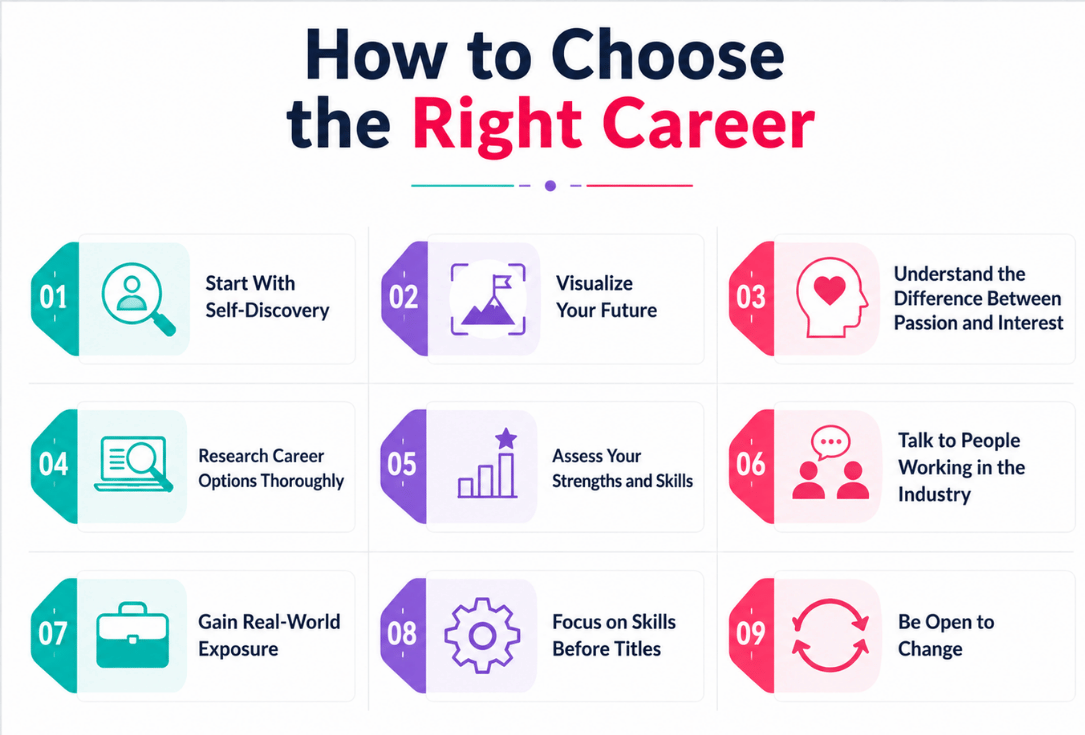
Step 1: Start With Self-Discovery
Before exploring career options, spend time understanding yourself.
Many students make the mistake of choosing careers based on peer pressure, family expectations, or current trends. Instead, start by asking yourself some important questions:
- What activities do I genuinely enjoy?
- Which subjects excite me the most?
- What are my natural strengths?
- Do I enjoy solving problems, creating things, helping people, or leading teams?
- Do I prefer working indoors, outdoors, independently, or collaboratively?
- What motivates me every day?
Your answers can provide valuable clues about careers that may be a good fit.
Understanding your interests is often the first step toward finding meaningful work.
Step 2: Visualize Your Future
A helpful exercise is to imagine where you would like to be ten years from now.
You don’t need a perfect answer.
Simply think about:
- What kind of work you might enjoy
- The lifestyle you want
- The impact you want to create
- The environment you want to work in
- The skills you want to develop
For example:
- If you enjoy technology and innovation, you may thrive in software development or AI.
- If you enjoy helping people, careers in healthcare, education, or counseling may appeal to you.
- If you enjoy creativity, fields such as design, marketing, content creation, or filmmaking may be worth exploring.
This exercise helps connect your career choices with your long-term aspirations.
Step 3: Understand the Difference Between Passion and Interest
One of the biggest misconceptions about career planning is assuming that every interest should become a career.
In reality, there is a difference between passion and interest.
An interest is something you enjoy.
A passion is something you are willing to invest significant time, effort, and energy into mastering.
For example:
- You may enjoy watching movies but have no desire to work in the film industry.
- You may enjoy playing sports recreationally but feel passionate about sports management, coaching, or fitness training.
Creating separate lists for your interests and passions can help clarify potential career directions.
Once you identify your passions, research professions that align with them.
Step 4: Research Career Options Thoroughly
After identifying a few potential career paths, start researching them in detail.
Learn about:
- Job responsibilities
- Required qualifications
- Industry growth trends
- Salary expectations
- Future demand
- Career progression opportunities
Many students choose careers without fully understanding what professionals actually do on a daily basis.
The more information you gather, the better your decision-making will be.
Remember, a career should not only interest you today but should also provide growth opportunities for the future.
Step 5: Assess Your Strengths and Skills
Career decisions should be based on both passion and capability.
This is where an aptitude test can be extremely useful.
Aptitude assessments help identify your natural strengths in areas such as:
- Logical reasoning
- Numerical ability
- Communication
- Creativity
- Problem-solving
- Critical thinking
- Leadership
These insights can help you discover careers that align with your strengths rather than relying solely on assumptions.
Modern AI-powered assessment platforms can also provide personalized career recommendations based on your performance, interests, learning preferences, and future potential.
Step 6: Talk to People Working in the Industry
One of the most effective ways to understand a career is to speak with professionals already working in that field.
Reach out through:
- Alumni networks
- Professional communities
- Industry forums
- Mentorship programs
Ask questions such as:
- What does a typical day look like?
- What skills are most important?
- What challenges should I expect?
- What advice would you give someone starting out?
These conversations often provide insights that cannot be found through online research alone.
Step 7: Gain Real-World Exposure
Before committing to a career path, try to experience it firsthand.
You can:
- Complete internships
- Participate in workshops
- Volunteer
- Take online projects
- Join competitions
- Attend industry events
Practical exposure helps validate whether your assumptions about a profession are accurate.
It also helps you build confidence and gain valuable experience.
Step 8: Focus on Skills Before Titles
The future belongs to people who continuously learn and adapt.
Instead of obsessing over job titles, focus on building the right skill set.
Skills such as:
- Communication
- Problem-solving
- Digital literacy
- Data analysis
- Creativity
- Collaboration
- Adaptability
are valuable across industries and professions.
The stronger your skills become, the more career opportunities you will create for yourself.
In today’s rapidly evolving workplace, employers increasingly hire based on skills and potential rather than degrees alone, making continuous learning more important than ever.
Step 9: Be Open to Change
Many students feel pressured to make a perfect career decision immediately.
The reality is that careers are rarely linear.
People switch industries, learn new skills, discover new interests, and pursue unexpected opportunities throughout their professional lives.
Choosing a career today does not mean you are locked into that path forever.
The goal is to make the best possible decision based on the information you currently have while remaining open to future growth and change.
Common Mistakes to Avoid
When choosing a career, avoid these common pitfalls:
- Following friends without considering your own interests
- Choosing a profession solely because of salary
- Ignoring your strengths and personality
- Making decisions based on social pressure
- Avoiding research and exploration
- Assuming one career choice determines your entire future
The best career decisions are thoughtful, informed, and aligned with both personal and professional goals.
Final Thoughts
Choosing the right career is a journey, not a one-time decision.
It requires self-awareness, exploration, research, practical experience, and continuous learning. By understanding your strengths, identifying your passions, exploring opportunities, and developing relevant skills, you can build a career that is both successful and fulfilling.
Remember, the objective is not to find a perfect career overnight. The objective is to find a direction that excites you, challenges you, and allows you to grow over time.
Talent Titan: Helping You Discover the Right Career Path
Talent Titan empowers students and young professionals through assessments, personalized analytics, skill development programs, learning resources, and career guidance tools.
Whether you’re exploring career options, identifying strengths, preparing for interviews, or developing future-ready skills, Talent Titan helps you make informed decisions and take confident steps toward your professional goals.
Because the best careers are built on informed choices, continuous learning, and the courage to explore new possibilities.
Other Articles

Beyond the Script: Using AI to Master Behavioral Interview Questions
How to Tackle C++ Coding Interview Questions with Confidence
The Secret to Answering Industry-Specific Interview Questions
How to prepare for domain-specific hiring questions across finance, tech, and healthcare.
Ready to Discover Your Ideal Career Path?
From AI-powered assessments and personalized career insights to skill development and interview preparation, Talent Titan helps students and young professionals make informed career decisions with confidence.