
How Agentic AI is Transforming Education and Workforce Development

Artificial Intelligence is no longer a futuristic concept. It has become an integral part of how businesses operate, how people work, and increasingly, how individuals learn and develop new skills.
Today, Artificial intelligence is penetrating all walks of life: from healthcare and finance to recruitment, manufacturing, customer service, and workforce management. Among the many sectors being transformed, Education and Learning is experiencing one of the most significant shifts.
For decades, learning followed a standardized approach. Students, employees, and professionals were expected to consume the same content, attend the same training sessions, and progress through identical learning pathways. While this model worked in a less dynamic world, it struggles to meet the demands of today’s rapidly evolving workplace.
Organizations now require employees to continuously upskill, adapt to emerging technologies, and build new capabilities at an unprecedented pace. At the same time, learners expect personalized experiences that align with their goals, strengths, and preferred learning styles.
This is where Artificial Intelligence is creating a fundamental transformation.
From Traditional Learning to Intelligent Learning
The biggest challenge with conventional learning systems is that they treat every learner the same.
In reality, every individual learns differently. Some learners absorb information quickly, while others require reinforcement and practice. Some prefer visual content, while others learn more effectively through hands-on experiences.
Modern AI-powered learning platforms solve this challenge by creating personalized learning experiences that adapt to individual needs.
Instead of delivering generic training programs, AI can analyze performance patterns, identify knowledge gaps, understand learning behavior, and recommend customized learning pathways.
This shift enables organizations to move from content delivery to outcome-driven learning.
The Rise of Agentic AI in Learning
Artificial Intelligence has already transformed how learning content is delivered.
The next evolution is Agentic AI.
Unlike traditional learning platforms that simply provide content libraries, Agentic AI systems can actively guide learners throughout their development journey.
Agentic AI can:
- Identify skill gaps
- Recommend learning paths
- Track progress continuously
- Adapt content dynamically
- Suggest next learning actions
- Measure learning outcomes
- Support workforce development goals
Rather than acting as a passive system, Agentic AI functions as an intelligent learning partner that continuously helps learners improve.
This makes learning more personalized, measurable, and effective.
How AI Enhances Learning Effectiveness
One of the biggest advantages of AI-powered learning is its ability to improve knowledge retention and learning outcomes.
Traditional training programs often struggle because learners receive large volumes of information regardless of relevance or readiness.
AI changes this by delivering the right content at the right time.
Through intelligent recommendations and continuous analysis, AI helps learners focus on the areas that matter most.
The result is:
- Faster skill acquisition
- Improved knowledge retention
- Higher engagement levels
- Better learning outcomes
- Increased productivity
Organizations can ensure that employees spend less time consuming unnecessary content and more time developing relevant capabilities.
Empowering Educators and Learning Leaders
There is often a misconception that Artificial Intelligence will replace educators and trainers.
The reality is quite the opposite.
An artificially intelligent assistant enables educators, trainers, and Learning & Development leaders to become more effective.
AI can help by:
- Monitoring learner performance
- Identifying learning challenges
- Generating progress reports
- Recommending interventions
- Providing actionable insights
By automating repetitive administrative tasks, learning leaders can focus on mentoring, coaching, and creating meaningful learning experiences.
Instead of replacing human expertise, AI amplifies it.
Skill Gap Identification and Workforce Development
One of the biggest challenges organizations face today is understanding workforce capability gaps.
Business requirements evolve rapidly, but employee skills do not always keep pace.
AI-powered learning systems help organizations identify:
- Existing competencies
- Emerging skill requirements
- Knowledge gaps
- Development priorities
This enables organizations to create targeted upskilling and reskilling initiatives that directly support business goals.
Rather than investing in generic training programs, organizations can focus on building the specific capabilities required for future success.
Beyond Training: Building Future-Ready Talent
Modern learning is no longer limited to technical training.
Organizations increasingly need employees who possess both technical expertise and human skills.
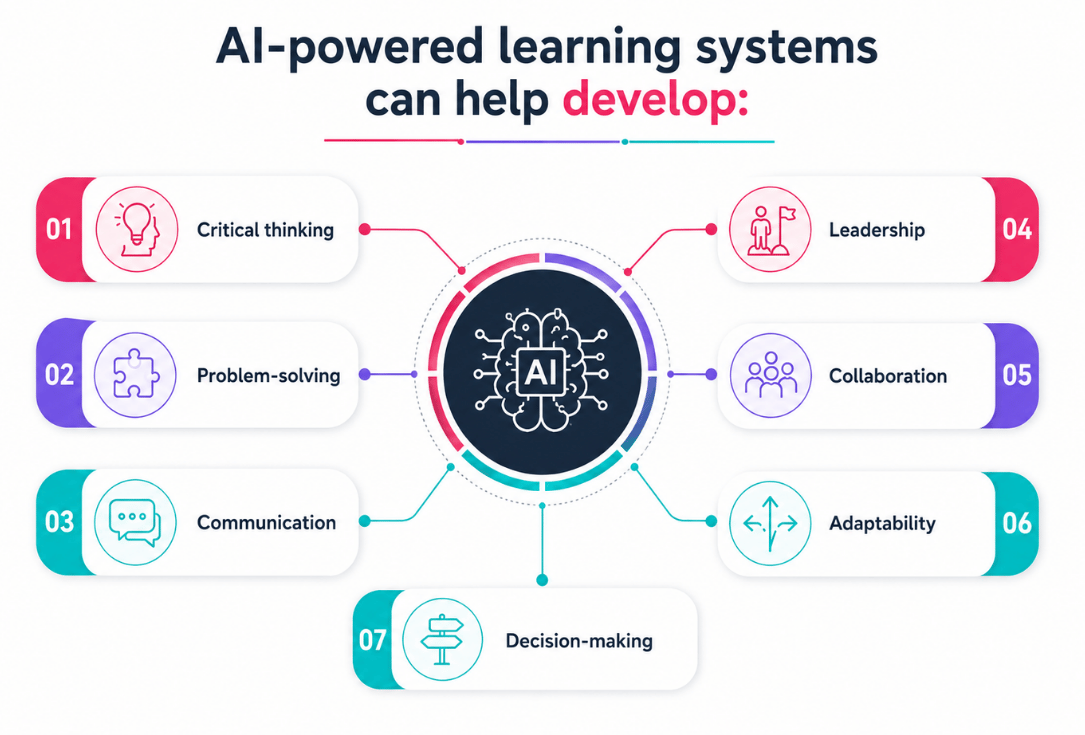
AI-powered learning systems can help develop:
- Critical thinking
- Problem-solving
- Communication
- Leadership
- Collaboration
- Adaptability
- Decision-making
These capabilities play a critical role in long-term career success and organizational growth.
This contributes significantly to the holistic development of students and professionals alike, preparing them for the evolving demands of the modern workforce.
LUMA: Talent Titan's AI-Powered Learning & Development Agent
At Talent Titan, learning goes beyond traditional training programs.
LUMA is Talent Titan’s AI-powered Learning & Development Agent designed to help organizations build future-ready workforces through intelligent, personalized learning experiences.
LUMA helps organizations:
- Identify workforce skill gaps
- Create personalized learning journeys
- Recommend relevant learning content
- Track learner progress
- Measure training effectiveness
- Support upskilling and reskilling initiatives
- Improve workforce readiness
By combining AI, analytics, and continuous learning intelligence, LUMA enables organizations to transform learning from a periodic activity into an ongoing development journey.
The result is a workforce that is more agile, skilled, and prepared for future business challenges.
The Future of Education and Learning
The future of learning will not be defined by larger content libraries or longer training programs.
It will be defined by intelligence, personalization, and continuous development.
As organizations continue to embrace digital transformation, learning systems must evolve from static platforms into intelligent ecosystems that actively support growth and performance.
Agentic AI is making this possible by creating learning experiences that are adaptive, data-driven, and learner-centric.
The combination of human expertise and intelligent technology is enabling a future where learning is no longer reactive but proactive.
Looking Ahead
Artificial Intelligence is transforming how people learn, develop skills, and prepare for future opportunities.
From personalized learning pathways and skill gap analysis to workforce development and intelligent learning recommendations, AI is redefining what effective learning looks like.
Platforms like Talent Titan’s LUMA are helping organizations move beyond traditional training models toward a future where learning is continuous, measurable, and aligned with business outcomes.
Because the future of Education and Learning is not just about delivering knowledge.
It is about helping people learn smarter, grow faster, and unlock their full potential through the power of Agentic AI.
Other Articles
Beyond the Script: Using AI to Master Behavioral Interview Questions
How to Tackle C++ Coding Interview Questions with Confidence
The Secret to Answering Industry-Specific Interview Questions
How to prepare for domain-specific hiring questions across finance, tech, and healthcare.
Ready to Transform Learning with Agentic AI?
Build a future-ready workforce with LUMA’s AI-powered learning journeys, skill intelligence, and workforce development solutions.