

The way organizations hire talent has changed dramatically over the last decade.
Traditional recruitment methods that relied heavily on resumes, job boards, and face-to-face interviews are being complemented, and in some cases replaced, by technology-driven hiring strategies. Organizations today are competing for talent in a highly dynamic market where candidate expectations are evolving just as quickly as recruitment technology.
The rise of startups, remote work, artificial intelligence, social platforms, and digital-first hiring experiences has fundamentally transformed how companies attract, evaluate, and hire talent.
Modern recruiters are constantly searching for innovative ways to identify exceptional candidates, reduce hiring timelines, improve candidate experience, and build stronger teams.
The goal is simple: ensure that great talent never slips through the cracks.
Let’s explore some of the most impactful hiring trends that are reshaping recruitment today.
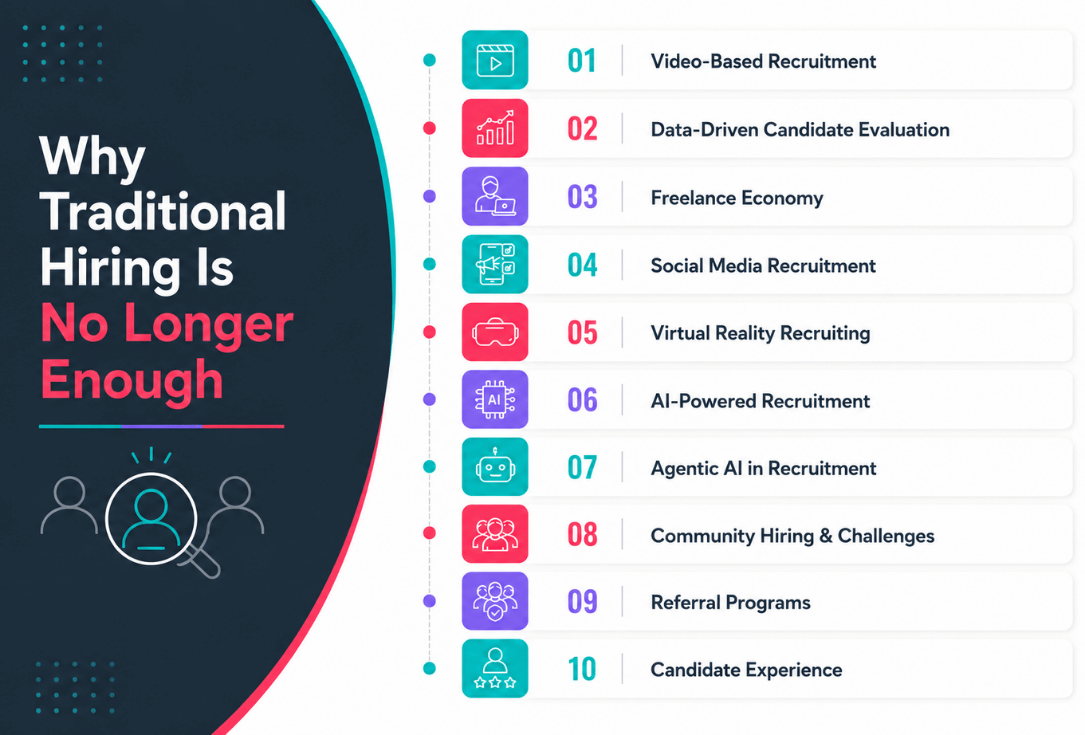
Why Traditional Hiring Is No Longer Enough
Hiring has become significantly more competitive.
Candidates today have access to more opportunities than ever before. At the same time, organizations are searching for specialized skills that are increasingly difficult to find.
The traditional approach of posting a job and waiting for applications often limits access to qualified candidates.
Modern recruitment strategies focus on:
- Expanding candidate reach
- Improving hiring efficiency
- Enhancing candidate engagement
- Reducing hiring costs
- Leveraging data-driven decision-making
- Creating memorable recruitment experiences
Today’s hiring teams are expected to move faster while maintaining quality. This has created demand for intelligent recruitment platforms that can automate repetitive tasks, generate hiring insights, and improve decision-making without compromising the human element of recruitment.
1. The Rise of Video-Based Recruitment
One of the most significant changes in recruitment has been the adoption of video interviewing as a core part of the hiring process.
Video interviews allow recruiters and candidates to connect regardless of location, making recruitment faster and more accessible.
Benefits include:
- Reduced scheduling challenges
- Lower travel costs
- Faster hiring cycles
- Improved candidate convenience
- Access to wider talent pools
Beyond traditional video interviews, organizations are increasingly adopting one-way interview platforms where candidates record responses to predefined questions.
This approach allows recruiters to review responses at scale while maintaining consistency across evaluations.
Modern interview platforms also leverage AI to generate insights related to communication skills, confidence, and behavioral indicators.
Many organizations are now combining video interviewing with AI-powered interview intelligence to evaluate communication skills, behavioral indicators, and role readiness more consistently across large candidate volumes.
2. Data-Driven Candidate Evaluation
Resumes alone rarely provide a complete picture of a candidate’s potential.
Organizations are increasingly relying on pre-employment assessments to evaluate technical abilities, cognitive skills, behavioral competencies, communication capabilities, and role-specific expertise.
Assessment-driven hiring offers several advantages:
- Better hiring accuracy
- Reduced bias
- Faster candidate screening
- Objective evaluation criteria
- Improved quality of hire
Many organizations now combine assessments with analytics to create a more comprehensive view of candidate suitability before interviews even begin.
Modern organizations are increasingly moving toward skills-based hiring models where candidate capability matters more than credentials alone. Assessments, analytics, and hiring intelligence help recruiters identify potential more accurately than traditional resume screening.
3. Leveraging the Freelance Economy
The growth of freelancing has introduced new opportunities for employers.
Organizations often require specialized expertise for short-term projects, consulting assignments, or temporary business needs.
Instead of committing to permanent hires immediately, companies can engage freelancers through digital talent marketplaces.
Benefits include:
- Faster access to niche expertise
- Reduced hiring costs
- Greater flexibility
- Project-based scalability
- Access to global talent
Freelance engagements also provide organizations with an opportunity to evaluate potential future hires in real-world scenarios before extending full-time employment offers.
4. Social Media Recruitment
Social media has become one of the most powerful recruitment channels available today.
Candidates frequently research employers online before applying, making employer branding more important than ever.
Organizations are using platforms such as LinkedIn, Instagram, X, YouTube, and niche professional communities to:
- Promote job opportunities
- Showcase company culture
- Highlight employee success stories
- Engage passive candidates
- Build employer brand awareness
Recruitment is increasingly becoming a marketing function where storytelling and engagement play a critical role in attracting talent.
The ability to target specific audiences based on interests, skills, and demographics makes social media a highly effective sourcing channel.
5. Virtual Reality and Immersive Hiring Experiences
As technology advances, organizations are exploring new ways to engage candidates.
Virtual Reality (VR) is emerging as a powerful tool for employer branding and candidate engagement.
Companies can use VR experiences to:
- Showcase workplaces
- Simulate job environments
- Demonstrate company culture
- Conduct immersive training experiences
These experiences provide candidates with a realistic understanding of the organization before they even join.
For employers, VR also sends a strong message about innovation and technological maturity.
6. AI-Powered Recruitment
Artificial intelligence is transforming every stage of the hiring process.
Modern AI solutions help organizations:
- Screen resumes
- Match candidates to roles
- Schedule interviews
- Analyze candidate responses
- Generate hiring insights
- Improve recruitment efficiency
AI does not replace recruiters.
Instead, it enables recruiters to spend less time on repetitive administrative tasks and more time building relationships with candidates.
The latest evolution of recruitment technology is Agentic AI, where specialized AI agents collaborate across sourcing, assessments, interviews, scheduling, onboarding, and workforce development to streamline hiring operations while keeping recruiters in control of final decisions.
The result is faster, smarter, and more scalable recruitment.
7. The Rise of Agentic AI in Recruitment
Recruitment platforms are evolving beyond standalone automation tools. Modern organizations increasingly need connected ecosystems that can manage multiple hiring activities from a single platform.
Agentic AI introduces specialized AI agents that work together across the recruitment lifecycle. These agents can source candidates, conduct assessments, coordinate interviews, generate hiring insights, engage applicants, and support onboarding activities.
This approach reduces manual effort, improves recruiter productivity, and creates a more seamless experience for candidates.
8. Recruitment Challenges and Community Hiring
Many organizations are moving beyond traditional applications and creating interactive hiring experiences.
Hackathons, coding competitions, business challenges, innovation contests, and community engagement initiatives allow organizations to identify talent based on demonstrated skills rather than resumes alone.
These initiatives provide recruiters with a direct view of candidate capabilities while creating stronger engagement among participants.
One notable example is the Accolite Hiring Challenge which demonstrated how referral-based hiring campaigns and large-scale talent engagement initiatives can help organizations reach broader candidate communities while creating meaningful incentives for participation.
Such models continue to influence how organizations think about community-driven hiring and employer branding.
9. Employee Referral Programs
Employee referrals remain one of the most effective hiring strategies available.
Employees often have access to professional networks filled with individuals who share similar skills, values, and work ethics.
Referral programs help organizations:
- Reduce hiring costs
- Improve hiring quality
- Accelerate recruitment timelines
- Increase employee retention
Candidates hired through referrals often integrate into company culture more quickly because they already have trusted connections within the organization.
10. Candidate Experience as a Competitive Advantage
Today’s candidates evaluate organizations just as carefully as organizations evaluate them.
A slow, confusing, or impersonal recruitment process can cause even highly qualified candidates to withdraw from consideration. As a result, organizations are increasingly focusing on creating seamless, transparent, and engaging hiring journeys.
Key elements of a positive candidate experience include:
- Timely communication
- Transparent hiring timelines
- Personalized engagement
- Easy application processes
- Constructive feedback
- Mobile-friendly experiences
Candidates who have a positive recruitment experience are more likely to accept offers, recommend the organization to others, and maintain a favorable perception of the employer brand, even if they are not selected.
Modern AI-powered recruitment platforms help organizations deliver consistent candidate experiences at scale by automating communication, providing real-time updates, and ensuring candidates remain engaged throughout the hiring journey.
Building a Stronger Talent Pipeline
Modern hiring is no longer focused solely on filling immediate vacancies.
Organizations are increasingly investing in long-term talent communities and relationship-building initiatives.
The objective is to create a sustainable talent pool that can support future hiring needs.
Talent communities may include:
- Former applicants
- Interns
- Freelancers
- Referral networks
- Campus talent
- Industry professionals
By nurturing these relationships over time, organizations can significantly reduce future sourcing challenges.
The Role of Talent Titan in Modern Hiring
As recruitment continues to evolve, organizations need technology that supports every stage of the hiring journey.
Talent Titan has evolved into a comprehensive Agentic AI-powered talent ecosystem built around HIRA, its AI orchestration platform that connects specialized agents across hiring and workforce development.
The platform includes:
- TARA for AI-powered talent sourcing
- GEMMA for intelligent career page engagement
- MERITA for skills-based assessments
- OWVIE for AI-powered one-way interviews
- RIVIA for conversational AI interviews
- ALIGNOR for interview scheduling automation
- ANA for hiring intelligence and analytics
- CERA for candidate engagement and pre-boarding
- LUMA for AI-driven learning and workforce development
Through assessments, interviews, analytics, automation, and workforce intelligence, Talent Titan enables organizations to make smarter hiring decisions while improving efficiency, scalability, and candidate experience.
Final Thoughts
The future of hiring is being shaped by technology, data, automation, and candidate-centric experiences.
Organizations that continue relying solely on traditional recruitment methods risk missing opportunities to attract exceptional talent.
Whether through video interviewing, AI-driven assessments, referral programs, social media recruitment, virtual reality experiences, or talent communities, modern hiring strategies provide organizations with new ways to identify and engage high-potential candidates.
The future of recruitment will belong to organizations that successfully combine human expertise with AI-driven intelligence. Recruiters will increasingly act as strategic talent advisors, supported by AI systems that automate operational tasks and provide actionable hiring insights.
The most successful organizations will be those that combine innovative technologies with human judgment to create recruitment experiences that are efficient, engaging, and effective.
As the talent landscape continues to evolve, embracing new ways of hiring is no longer optional. It is essential for building future-ready teams.
Other Articles
Beyond the Script: Using AI to Master Behavioral Interview Questions
How to Tackle C++ Coding Interview Questions with Confidence
The Secret to Answering Industry-Specific Interview Questions
How to prepare for domain-specific hiring questions across finance, tech, and healthcare.
Ready to Modernize Your Hiring Strategy?
From AI-powered sourcing and assessments to intelligent interviews, candidate engagement, and hiring analytics, Talent Titan’s Agentic AI ecosystem helps organizations hire smarter, faster, and at scale.