Hiring has quietly become one of the most inefficient processes inside most organizations. Job openings remain elevated, yet hiring activity is slowing. According to the Society for Human Resource Management (SHRM), the average time-to-fill has increased to 44 days, up from 33 days in 2021, while recruiters now conduct an average of 20 interviews per hire, compared to 14 in 2021*. These trends point to increasingly complex and resource-intensive hiring processes.
(Source: Society for Human Resource Management (SHRM), 2025 Recruiting Executives Benchmarking Data Brief, 2025.)*
Teams are smaller, requisition loads are heavier, and the funnel is noisier than it has been in years. Against that backdrop, it’s no surprise that AI has moved from an interesting pilot to a core part of the hiring stack. The real question for talent leaders in 2026 isn’t “should we use AI in interviews” — it’s “how effective is it, and how far can it responsibly go.” This blog looks at both: the measurable impact of AI-driven interviewing today, the deeper shift toward agentic AI in HR, and what that combination means for the eight pain points that quietly drain every recruiting team’s time.
Why manual interviewing is breaking down?
Before looking at what AI changes, it’s worth looking exactly where the manual process fails. These aren’t hypothetical friction points — they show up in benchmarking data year after year.
1. Sourcing, screening, and interview scheduling continue to consume a significant share of recruiter capacity. Coordinating calendars across candidates, interview panels, and hiring managers remains one of the most time-intensive stages of the hiring process. According to Gem’s 2025 Recruiting Benchmarks Report, recruiters now manage an average of 14 open requisitions each—a 56% increase over the past three years—while the average recruiting team has shrunk from 31 members to 24*. As recruiter workloads increase and team sizes decline, manual scheduling, candidate screening, and interview evaluation become increasingly difficult to scale.
(Gem. (2025). 2025 Recruiting Benchmarks Report)*
2. Resumes and screening calls can’t reveal communication or real-world skills. A resume tells you what someone claims to have done. It says almost nothing about how they think under pressure, how they communicate, or how they’d actually perform in the role. Every recruiter has felt the gap between a polished resume and a candidate who can’t articulate their own experience in a live conversation.
3. Interviewers’ focus on core work leaves insufficient capacity for interviewing. Engineers, managers, and specialists who are pulled in to interview are, by definition, being pulled away from their actual jobs. As interview volume per hire keeps climbing, that tax on already-stretched teams compounds.
From live conversations to async recordings to human-led panels — one agentic AI layer across every interview format.
4. Difficulty identifying high-potential candidates. Without effective pre-screening, interviewers are required to assess many candidates who do not meet the role requirements. Combined with varying levels of domain expertise across interview panels, this can lead to inconsistent evaluations, overlooked talent, and valuable interview time being spent on low-fit candidates.
5. Delays in coordination and interview feedback cause top candidates to drop off and weaken hiring decisions. Slow scheduling, delayed interviewer feedback, and repeated follow-ups extend the hiring process, giving competing employers more time to secure top talent. Around a quarter of candidates disengage between the interview and offer stage, while 42% drop out specifically because scheduling takes too long*. Even when feedback is eventually submitted, it is often brief and subjective rather than structured and consistent, making it difficult to compare candidates fairly and make confident hiring decisions.
(RecruitBPM, 2026)*
Individually, each of these looks like a minor operational annoyance. Together, they explain why cost-per-hire and time-to-hire have both risen over the past three years — the very period when AI adoption in HR surged from 26% to 43%* . Adoption alone doesn’t fix a broken process; it has to be applied to the right parts of it.
(SHRM, 2026)*
From "AI-assisted" to "agentic": what's actually changing in 2026?
Most of the AI tools that entered recruiting over the last few years were fundamentally reactive — a chatbot that answers a question, a model that scores a resume when asked, a scheduling assistant that proposes times when prompted. Useful, but passive. Agentic AI is a different category: systems that sense a trigger, plan a multi-step sequence of actions, execute across tools and systems, and carry context forward from one step to the next — without waiting for a human to prompt every action.
The shift is happening fast. Gartner’s CHRO Priorities research found that 82% of HR leaders plan to deploy agentic AI capabilities within the next 12 months, and separately predicted that 40% of enterprise applications will include task-specific AI agents by the end of 2026, up from under 5% just a year earlier.
In interviewing specifically, “agentic” means the system doesn’t just help a recruiter conduct or score an interview when asked. Instead, it recognizes when a candidate reaches the interview stage in the ATS, initiates the interview or observation, adapts its own questioning or analysis in real time based on what the candidate says, produces a structured output, and hands the result to the next step in the pipeline — in a continuous loop that runs for every candidate without a recruiter manually triggering each stage.
What agentic interviewing looks like in practice?
Mapped against the pain points above, agentic AI can realistically address each stage of the interview lifecycle — not as one monolithic tool, but as a set of purpose-built capabilities that hand off to each other automatically:
Before the interview — autonomous scheduling and triggering. An agent that watches the ATS pipeline and automatically initiates the next step the moment a candidate clears a stage removes the single biggest source of manual coordination work (requisition overload and low-quality-candidate triage), and directly attacks the #1 cause of candidate drop-off: scheduling delay.
During the interview — live, adaptive, or self-paced evaluation. This is where the “resumes can’t reveal communication skills” problem actually gets solved — not by asking more questions, but by asking better, adaptive ones and evaluating the response consistently. Two agentic models have emerged here: a live conversational agent that conducts a real-time voice/video interview and adjusts its follow-up questions based on what the candidate says, and an asynchronous agent that lets candidates record responses on their own schedule while AI evaluates communication, functional skills, and confidence the moment the recording is submitted. Together, these models deliver consistent evaluations, reduce manual effort, and enable interviewers to focus their time on the most promising candidates.
During human-led interviews — real-time observation and analysis. Not every interview needs to be replaced by an AI agent. Many organizations still want a human interviewer for later-stage or senior conversations. Here, agentic AI can join as a silent observer, analyzing the conversation from both the interviewer’s and candidate’s side in real time, and generating a structured, bias-reduced scorecard the moment the interview ends. That closes the two most persistent feedback failures — delayed feedback and shallow, inconsistent feedback — without changing how the interview itself is run.
After the interview — structured, auditable output. Across all three of these agentic layers, the output should look the same: not a subjective gut reaction, but a structured, comparable scorecard tied to defined competencies, fully auditable, and delivered instantly rather than after days of reminders.
This three-layer model — AI-led live interviewing, asynchronous evaluations, and AI-powered interview analysis — is exactly what Talent Titan’s AI interview agents were built to deliver. Here’s what that looks like in practice.
Meet the agents: RIVIA, OWVIE, and ANA
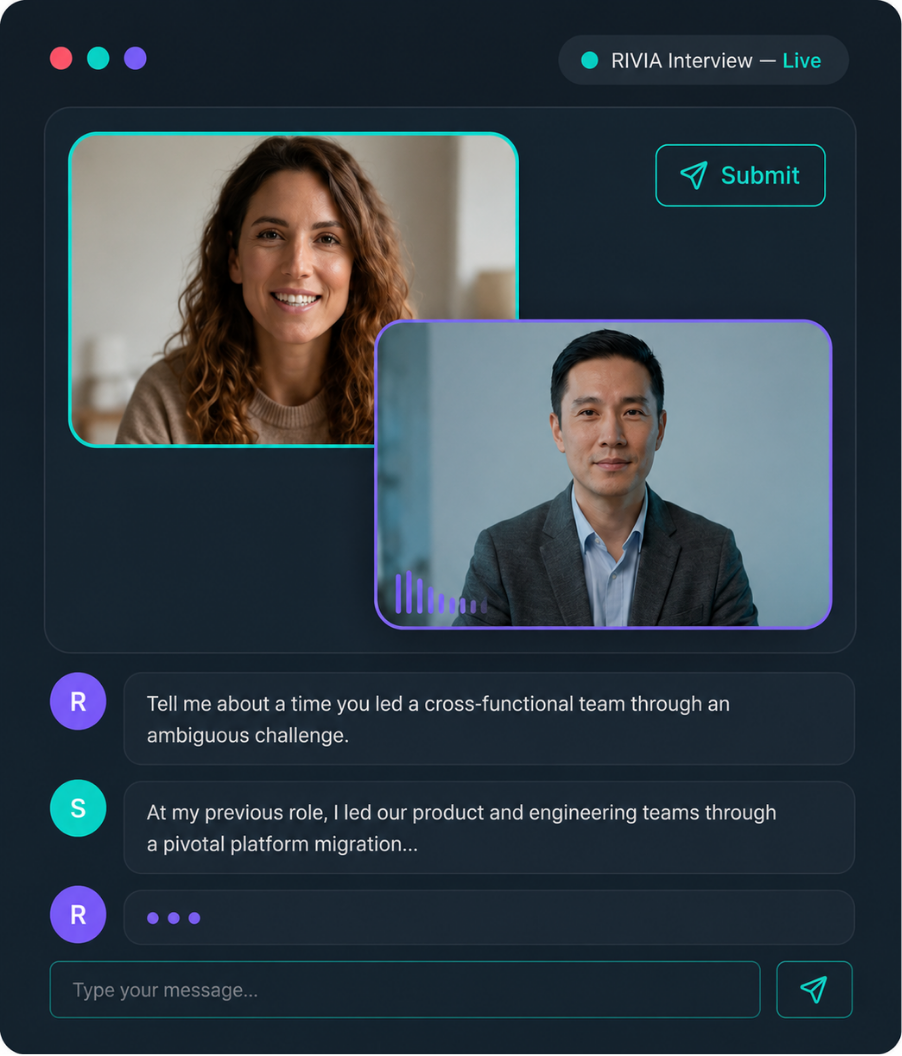
RIVIA — The real-time interactive AI interview agent
RIVIA conducts conversational AI interviews with dynamic, role-specific questioning and instant, structured scorecards based on the job description. It is fully autonomous, running interviews with zero human intervention, 24 hours a day. Organizations can also personalize both the avatar and voice to deliver a candidate experience that reflects their brand.
RIVIA is the closest thing to putting a live interviewer in front of every candidate, at scale, without the scheduling bottleneck. Instead of a fixed script, RIVIA listens to what a candidate says and dynamically adjusts its next question — probing a vague answer, asking for a concrete example, or moving on when a competency has clearly been demonstrated. This is what most separates it from older AI interview tools: the conversation actually goes somewhere, instead of marching through a static list.
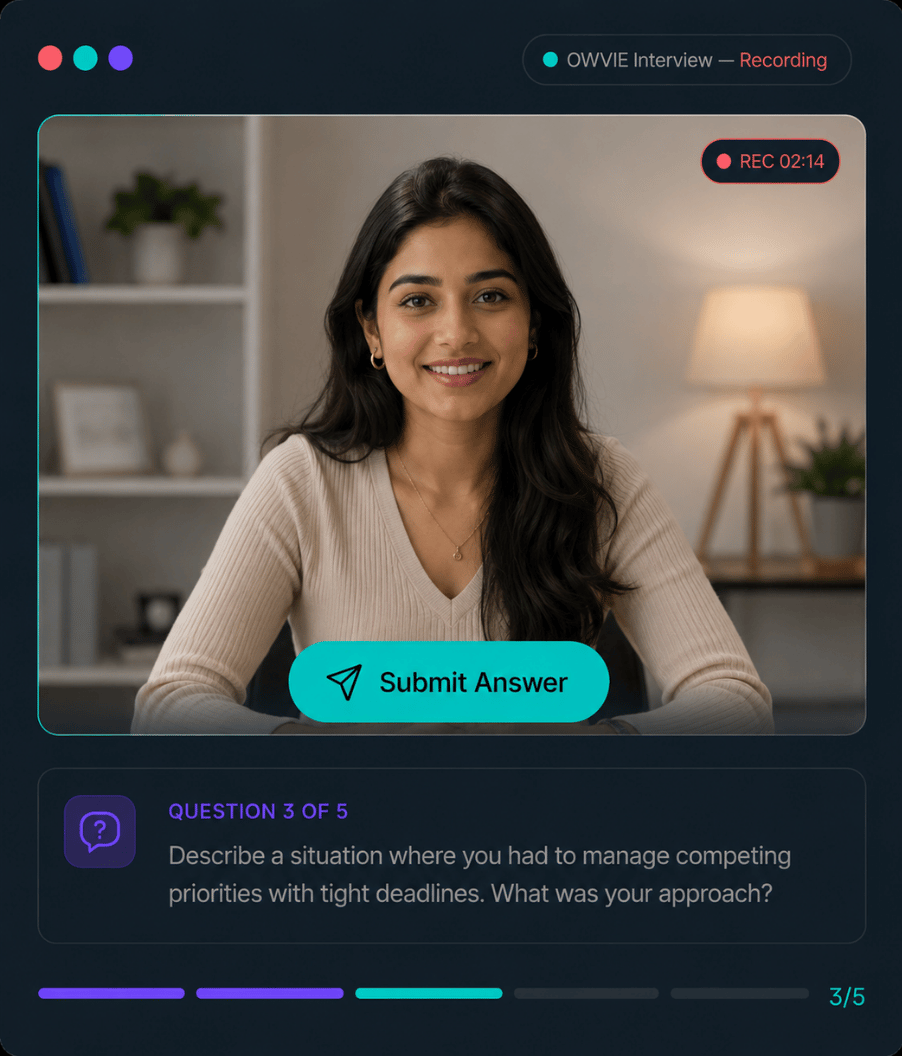
OWVIE — The async interview AI evaluation agent
OWVIE lets candidates record their responses on their own schedule. It then autonomously evaluates skills, communication, and confidence, delivering structured insights instantly with zero scheduling and zero bias.
Not every interview needs to happen live, and not every candidate can make a fixed time slot work, especially at high volume, across time zones, or for early-career hiring where hundreds of candidates need to be screened before a single human panel is convened.
OWVIE exists for exactly this scenario. Candidates record video or audio responses whenever and wherever suits them, on any device, and OWVIE evaluates the response the moment it lands, without waiting on a reviewer’s calendar.
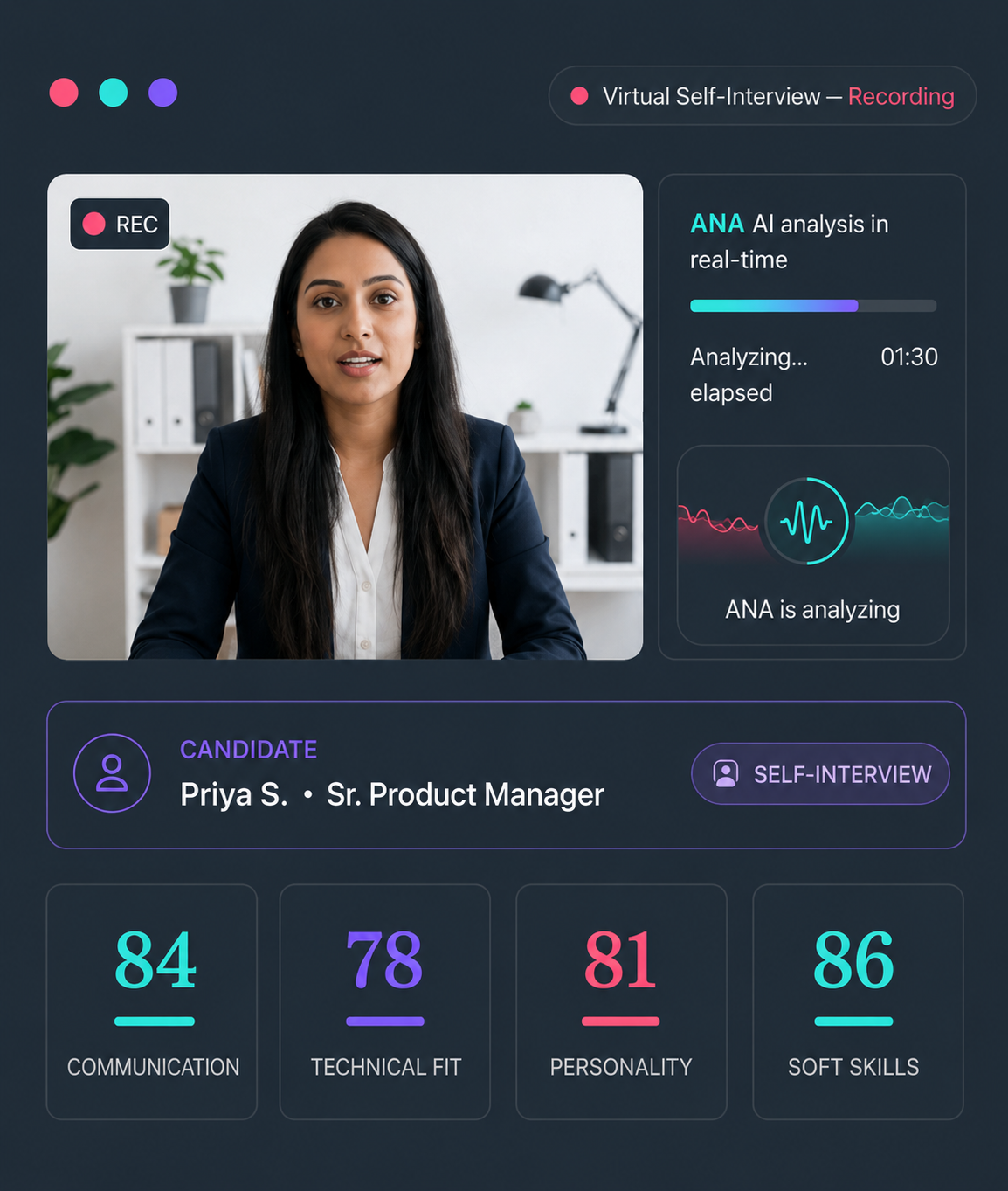
ANA — The interview analysis AI agent
ANA analyzes human-conducted interviews in real time and produces structured, bias-reduced evaluation scorecards, without changing how your interviewers already work.
Not every interview should be automated end-to-end. Plenty of organizations, especially for senior or client-facing roles — still want a human panel in the room. ANA is built for exactly that reality. Rather than replacing the human interviewer, ANA joins the call as an autonomous observer, listens to the entire conversation from both the interviewer’s and the candidate’s side, and turns it into the same kind of structured, comparable scorecard that RIVIA and OWVIE produce. It is agentic AI applied not to conducting the interview, but to making sure nothing said in it is lost, forgotten, or evaluated inconsistently.
RIVIA vs. OWVIE vs. ANA: which agent fits which interview?
| Agent | Format | Best Used For |
|---|---|---|
| RIVIA | Live, real-time AI-conducted interview | High-volume first-round or mid-funnel screening where a dynamic, conversational interview adds signal beyond a resume. |
| OWVIE | Asynchronous, self-recorded interview | Large applicant pools, campus hiring, and time-zone-spread candidates who need flexibility to record on their own schedule. |
| ANA | Human-led interview with AI observation | Senior, technical, or client-facing roles where a human panel remains, but consistent, auditable evaluation is still required. |
Used together, the three agents form a single agentic AI layer across the entire interview stage of hiring — live, asynchronous, and human-led — each auto-triggering directly from ATSs such as Lever, Greenhouse, Darwinbox, TurboHire, and Zoho Recruit, without recruiters needing to manually push candidates from one tool to the next.
The bigger shift: from AI tools to agentic AI systems
The real transformation in hiring isn’t just the adoption of AI — it’s the shift from standalone AI tools to intelligent AI agents that can execute entire workflows. For years, AI in recruitment meant disconnected point solutions: a resume parser, a chatbot, a scheduling assistant, or an assessment platform, with recruiters manually coordinating the handoffs between them. Agentic AI changes this paradigm by enabling AI agents to independently understand context, make decisions, take action, and seamlessly progress candidates through the hiring journey.
This shift is particularly powerful in interviewing, where speed and consistency directly impact hiring outcomes. Top candidates often receive multiple offers, and delays in scheduling, conducting interviews, or collecting feedback can result in losing them to competitors. AI interview agents dramatically reduce these bottlenecks by conducting interviews on demand, generating instant evaluations, and keeping the hiring process moving without sacrificing assessment quality. In fact, standardized evaluation frameworks often make hiring decisions more objective and reliable than traditional interview processes.
It also creates a more consistent and equitable interview experience. Human evaluations can vary depending on interviewer fatigue, bias, or inconsistency across panels.
Agentic AI agents like RIVIA, OWVIE, and ANA apply the same competency framework to the first candidate and the five-hundredth, at 9 a.m. or 9 p.m. — a meaningfully different guarantee than any individual human interviewer can offer.
What this means for hiring teams and candidates?
For talent acquisition teams, the practical upside is straightforward: fewer hours lost to coordination, faster time-to-hire, and interview data that is actually structured enough to compare across a full applicant pool rather than living in scattered notes and gut impressions.
For candidates, the upside is less obvious but arguably more important — a fair shot at being evaluated on how they actually communicate and think, at a time that works for them, without the process stalling out for weeks after a strong conversation.
None of this eliminates the human role in hiring. If anything, it protects it. When agentic AI agents handle the repetitive, high-volume, and structurally consistent parts of interviewing — engaging, adapting, assessing, and reporting — the humans left in the loop can spend their time on the part only humans are good at: building a relationship with the candidate they are about to hire.
See RIVIA, OWVIE & ANA run a full interview loop.
From live conversations to async recordings to human-led panels — one agentic AI layer across every interview format.
Other Articles
New-Age Recruitment Trends and Tools Shaping the Future of Hiring

How to Hire the Best Talent Through a Seamless & Effective Recruitment Process